Majic AI / Toolbox / Majic Bid Board
Case study · Construction · Estimating
From bid invitation to priced proposal, the same day.
Low-voltage contractors were passing on bids they never had time to price. We built a board for LKConline and other low-voltage contractors that pulls every invitation in, reads the plan set, counts the devices and drafts the proposal, and leaves the judgment to a person.
406
bid invitations screened
154,768
plan pages read
187
priced proposals sent
Same day
turnaround on most packages
Counts are from the first contractor on the platform, our own five-person company, for July 31 to September 30, 2026.
The problem
The bids were there. The hours were not.
Invitations arrive from every direction: BuildingConnected, email, Bonfire, SAM.gov and public agency portals. Each one is a plan set that can run to hundreds of pages, and somebody has to open every sheet and count every device before a number can go out.
Done by hand, that is days per package. For a small contractor it means choosing which bids to walk away from, and the choice is made by the calendar instead of by which jobs are worth winning. Our own company had the problem first, so that is where the board was proven.
The work
What we built
One board for every invitation
Invitations sync in from BuildingConnected and from email, and public portals are watched for new solicitations. Each becomes a job card with the general contractor, the due date, the location and the trades.
A takeoff that reads the whole set
The drawings and specifications are read together, as the coordinated package they are. Every device is located and counted across the set, not one sheet in isolation.
Counts checked against the record
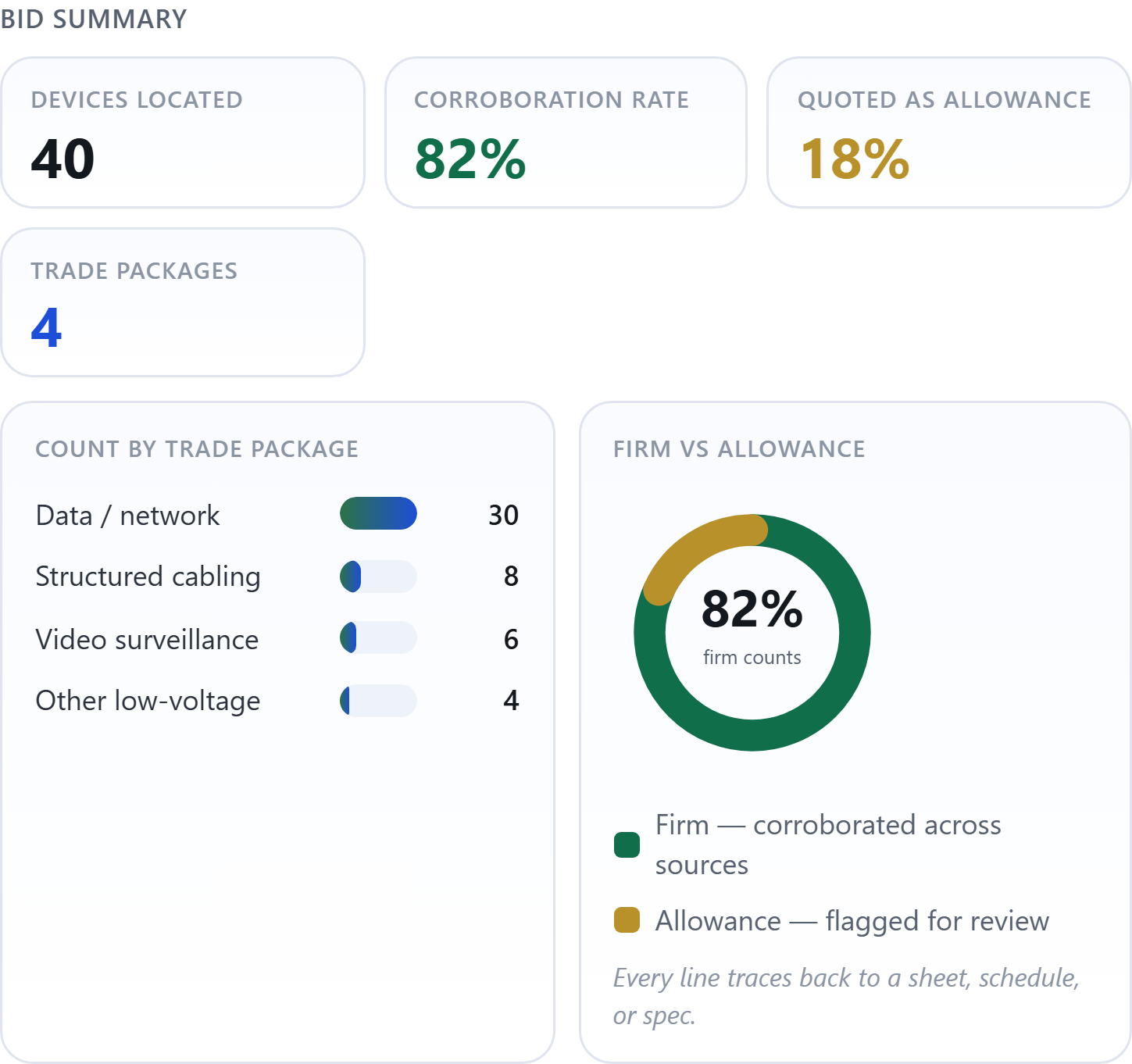
Counts are reconciled against the engineer's own device schedules and the written specifications. A count becomes firm only when the sources agree.
Gaps flagged, never guessed
Where the documents do not say, the line is quoted as a clearly marked allowance and surfaced for review. Nothing is invented, and every number traces back to a sheet.
Priced from your own book
The bid is priced against the contractor's own catalog and preferred vendors, and comes out as a proposal in the company's format with a field guide for the crew.
A person approves what goes out
Nothing is sent to a general contractor automatically. An estimator checks the numbers and approves the proposal, and the board tracks what was sent, to whom and for how much.
How it works
How a bid moves through it
Invitation arrives
From BuildingConnected, email or a public portal.
Job card created
Contractor, due date, location and plan files attached.
Plans read
Every sheet and spec section, devices located and counted.
Counts cross-checked
Against schedules and specs. Conflicts are flagged.
Priced and drafted
From the price book, into the company's proposal format.
Approved and sent
A person signs off. Status syncs back to the board.
Under the hood
- The models run on our own AI servers, not on a public AI service, so plan sets and pricing stay on hardware we control.
- Each company's jobs, contacts and prices are kept separate. A second contractor can be added without seeing anything of the first.
- The number actually sent is recorded against the job, so the board always shows what the client holds, not a recalculation.
Why it matters
What this means for your business
You probably do not bid construction work. But most businesses have a version of this job: a stack of documents that someone has to read before a decision can be made. The pattern is the same. The engine reads, counts and drafts, and a person approves what goes out.
Built for low voltage
It counts what a low-voltage estimator counts.
General takeoff tools are built around walls, floors and electrical. This one starts from the technology sheets.
Structured cabling
Data drops and outlets counted from the technology sheets, with cable measured instead of allowed for.
Wireless
Access points located and counted, with the drop each one needs carried in labor and materials.
Cameras
Interior and exterior cameras counted separately, because the mounting and the lift are not the same job.
Access control
Doors, readers, strikes and controllers, counted per door.
Telecom rooms
MDF and IDF racks, patch panels and switching, sized from the drops they serve.
Fiber
Backbones measured room to room along the route, never priced as an allowance.
| By hand | BuildingConnected alone | Majic Bid Board | |
|---|---|---|---|
| Collects invitations | Your inbox | Its own invitations | BuildingConnected, email and public portals on one board |
| Reads the plan set | You do | Not its job | Every sheet and spec section |
| Counts the devices | You do | Not its job | Yes, with the sheet behind each count |
| Prices from your book | A spreadsheet | Not its job | Your catalog and preferred vendors |
| Drafts the proposal | You do | Not its job | In your company's format |
| Approves what goes out | You | You | Still you |
BuildingConnected is a product of Autodesk and does its own job well: it is where invitations arrive and bids are logged. The board works with it, not in place of it.
Try it without a demo call
Send us a job you already bid.
Send a plan set you have already priced. We run it and send back the counts, each tied to its sheet, and you compare them to your own. If ours are wrong you will know in ten minutes.
Probably not a fit if
We would rather say so now.
- You bid from verbal scopes or sketches, with no drawings to read.
- You want a number sent without anyone checking it. We will not do that.
- Your trade is outside low voltage. It is built for cabling, wireless, cameras, access control and fiber.
Want something like this?
Tell us what you are trying to fix.
The people who built Majic Bid Board are the people you would work with. A first call costs nothing, and we will tell you plainly whether we are the right fit.